
Most small businesses set up a handful of conversion goals in their analytics tool, watch the numbers climb, and feel good about it. A form fill counts as one. A signup counts as one. A $4,000 enterprise order counts as one. The problem is obvious once you say it out loud: not all conversions are worth the same amount, yet most dashboards treat them as if they are. If you want to know whether your website is actually making money, not just generating clicks, you need to attach a dollar value to each goal.
Why click counts alone mislead you
Imagine two landing pages. Page A gets 200 form submissions a month. Page B gets 40. On a raw conversion count, Page A wins easily and probably gets more budget and attention. But if Page A's leads are mostly people downloading a free checklist, and Page B's leads are qualified buyers requesting a demo that closes at 30 percent, Page B is quietly worth far more to the business. Without goal values, you would never see that. You would keep pouring effort into the page that looks busiest instead of the one that pays the bills.
This is the trap that catches a lot of small teams. Analytics tools are built to count events well, but counting is not the same as measuring value. A goal value turns a count into a number that finance actually cares about.
What a goal value actually is
A goal value is a dollar amount (or your local currency) assigned to a specific conversion event. It can be a flat number or a dynamic one pulled from the transaction itself.
- Flat value: every newsletter signup is worth $2, because that is roughly what one subscriber is worth to you over time based on past email revenue.
- Tiered value: a demo request from a company with 50+ employees is worth $500, while a self-serve signup is worth $50, because your average deal size differs by segment.
- Dynamic value: an actual order total passed into the goal at the moment of purchase, so a $38 order and a $380 order are recorded as exactly what they are.
Most tools that support ecommerce tracking will let you pass dynamic values automatically. For lead generation businesses without a checkout, flat or tiered values based on your sales data are the more realistic option, and they are still far better than no value at all.
A conversion count tells you something happened. A goal value tells you whether it mattered.
How to figure out what a goal is actually worth
You do not need perfect numbers to start, you need reasonable ones based on data you already have.
- For ecommerce, use average order value by product category if you have enough volume to split it out.
- For lead gen, pull your CRM close rate and average deal size for the last two or three quarters, then multiply: a form fill that closes 10 percent of the time at a $2,000 average deal is worth roughly $200 to count as a goal value.
- For content or newsletter signups, use your email list's trailing revenue per subscriber, even if it is a rough estimate. $1 to $3 per signup is a common range for small businesses with a modest email program.
- Review and adjust these numbers quarterly. Close rates and deal sizes shift, and stale goal values will start lying to you just as badly as no values at all.
Setting values across different conversion types
Most sites have more than one type of conversion worth tracking, and they should not all carry the same weight.
- Macro conversions like a purchase, a signed contract, or a booked demo should carry your highest values, since they are closest to revenue.
- Micro conversions like adding to cart, starting a form, or watching a product video should carry smaller values that reflect how often they actually lead to a sale.
- Assisted conversions, where a visitor engages with a resource like a pricing page or case study before converting elsewhere, are worth tracking with a modest value too, since they show influence even when they are not the final step.
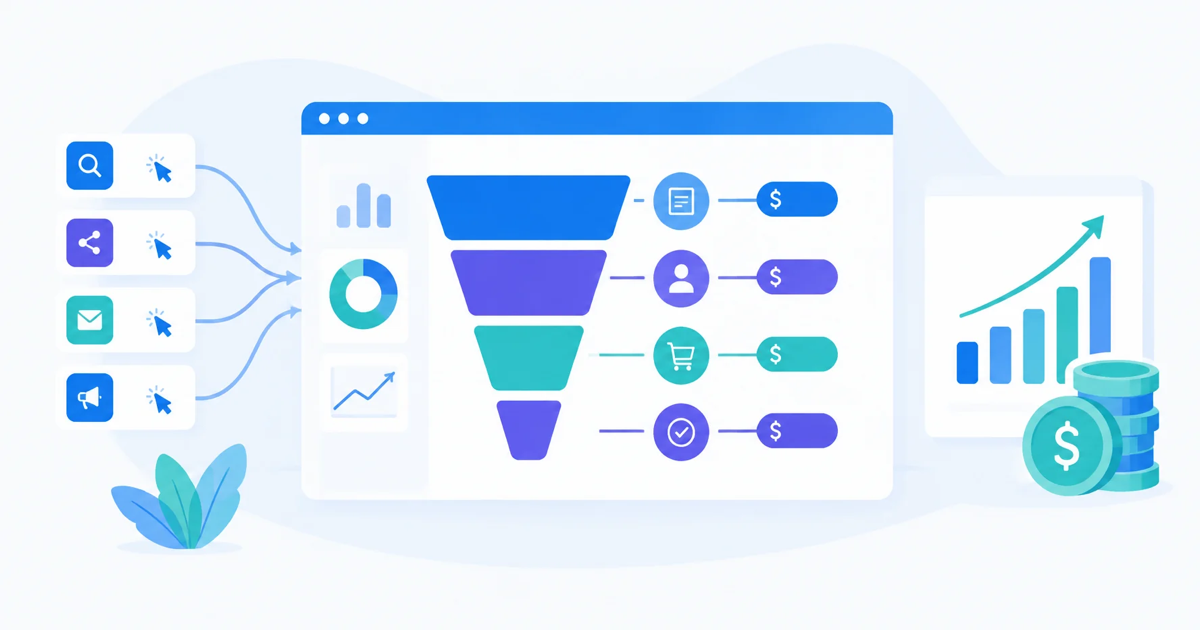
Once values are in place, your reporting changes shape entirely. Instead of asking "which page got the most clicks," you start asking "which page generated the most value," and those are often two very different pages.
Where session-level detail fills the gap
Goal values tell you how much a conversion is worth. They do not tell you why a visitor converted, or why ninety-nine others on the same page did not. That is where watching actual visitor behavior matters. A tool like LeadFnF layers session replay and funnel tracking on top of your conversion data, so once you know a page is generating high-value goals, you can watch real sessions to see exactly what visitors did right before converting, and what made the ones who left give up. It runs as a single lightweight script, keeps things privacy-first, and shows you funnels and replays in real time rather than after the fact.
That combination, a dollar figure attached to each goal plus the ability to watch the sessions behind the numbers, is what turns analytics from a vanity dashboard into something you can actually act on.
A simple way to start this week
You do not need a perfect valuation model on day one. Start with your top three goals, assign a rough dollar value to each based on close rate or average order value, and update your dashboard to show value instead of raw counts. Within a month you will likely notice at least one page or channel that looked mediocre on clicks but strong on value, or the reverse. That is the whole point: clicks tell you what happened, value tells you what to do next.
If you are still measuring success by counting clicks and form fills, you are only seeing half the picture. Try LeadFnF free and start pairing your conversion values with the session data that explains them.