FullStory is a genuinely impressive tool. Its autocapture approach, AI-powered session summaries, and enterprise-grade privacy controls are best-in-class. The problem is the price.
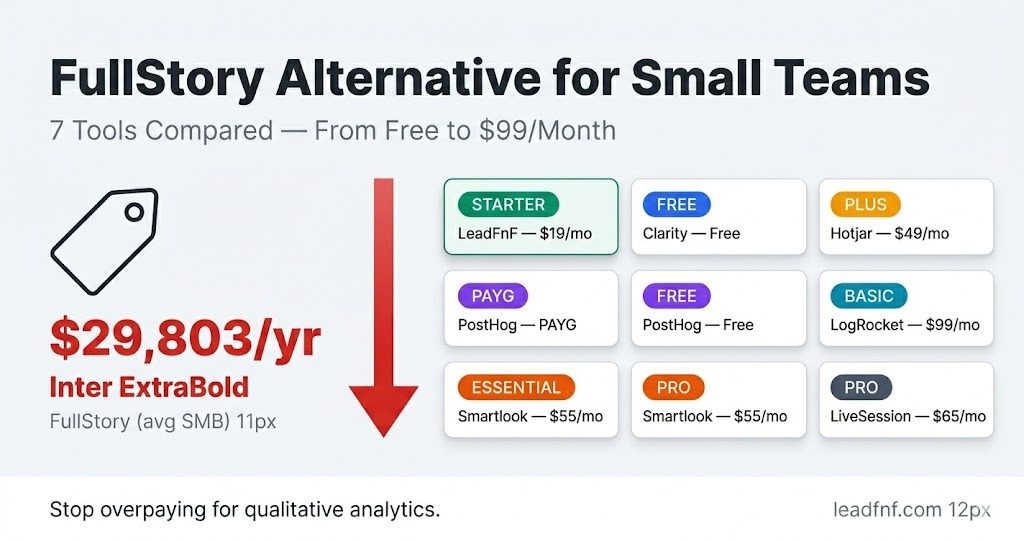
SMB contracts with FullStory average $29,803 per year based on actual customer spend data from SpendHound (SpendHound, May 2026). The Business tier starts at $199/month on annual billing, but user-reported costs frequently run $500–$750/month depending on session volume. For a small SaaS team of 2–10 people trying to understand why users aren't converting, that's an enormous price to pay for qualitative analytics.
FullStory is built for enterprise. That's not a criticism — it's a product decision. The tool assumes you have a dedicated UX researcher, a product analyst, and a procurement budget. Most small teams don't.
The good news: the core problem FullStory solves — watching what real users do on your product — can be addressed by a range of tools at $0 to $99/month. This guide covers the 7 best options, who each one is built for, and what you give up compared to FullStory.
Key Takeaways
- FullStory SMB plans average $29,803/year based on actual customer transactions. Enterprise contracts average $80,472/year (SpendHound, May 2026).
- FullStory's Business tier starts at $199/month (annual), but user-reported costs range $199–$750/month depending on session volume (CheckThat.ai, March 2026).
- Small teams (50,000–100,000 sessions/month) typically sign FullStory contracts between $10,000 and $25,000/year (Vendr, 2026).
- Microsoft Clarity is completely free — unlimited sessions, heatmaps, and AI summaries — making it the strongest zero-cost alternative for basic qualitative analysis.
- For small SaaS teams who need session recordings, heatmaps, AND traffic analytics in one tool, LeadFnF delivers all three at $19/month.
- PostHog is the best open-source alternative for engineering-led teams who want product analytics, session replay, and feature flags without FullStory's price or vendor lock-in.
Why FullStory Is Hard to Justify for Small Teams
Before the alternatives, it's worth being precise about what makes FullStory difficult at small scale.
Price opacity. FullStory does not publish pricing for its Business, Advanced, or Enterprise plans. Getting a quote requires a sales call. Once you're in a sales process, you're negotiating against their pricing rather than comparing options. Teams that don't know market benchmarks often pay 30–40% more than they should.
Session-based billing. FullStory charges based on session volume. At small scale (under 50K sessions/month), the free tier's 30,000 sessions may cover you. The moment you exceed that, you're looking at contracts starting at $10,000/year for the Business tier. One product launch or marketing campaign that drives traffic can push you into a tier you weren't budgeting for.
Enterprise-optimised UX. FullStory's interface is designed for teams with dedicated roles: UX researchers, product analysts, customer success engineers. Solo founders and small teams often find the depth of the tool overwhelming relative to the specific questions they're trying to answer.
Feature overhead. FullStory's StoryAI, Data Direct warehouse sync, and multi-org management are genuinely powerful features. They're also features that a 5-person SaaS team will never use — but they're part of what drives the price.
If any of the following describe you, you almost certainly don't need FullStory:
- You have fewer than 500,000 monthly sessions
- You don't have a dedicated UX or product analytics role
- You're spending more than 10 minutes a week trying to justify the bill
- You just need to watch session recordings and see heatmaps
Here are 7 tools that do that job better at your scale.
The 7 Best FullStory Alternatives for Small Teams
1. LeadFnF — Best All-in-One for Small SaaS ($19/month)
What it is: A web analytics platform that combines traffic analytics, session recordings, and click heatmaps in one script. Built specifically for founders and small SaaS teams who want the functionality of GA4 + Hotjar without the cost or complexity of multiple tools.
Best for: Solo founders, indie hackers, SaaS teams of 2–10 people who need session recordings AND traffic analytics in the same dashboard.
Key features:
- Session recordings with desktop (Chrome frame) and mobile (iOS frame) views
- Click heatmaps separated by device type — desktop, tablet, mobile
- Full traffic analytics — sessions, pageviews, sources, geography, device breakdown
- User flow graphs showing actual navigation paths between pages
- Funnel analysis with AI plain-English commentary
- Custom event tracking:
window.lf('event', 'upgrade_clicked') - Built-in GDPR consent banner — configurable position, text, and colours
- Automatic input masking — passwords, emails, card fields, checkout pages masked at capture
- Rage click and dead click detection built in
- Cookieless for traffic analytics — no consent banner needed for pageviews
Pricing: $19/month (Starter) — 14-day free trial, no credit card required.
What you give up vs FullStory: No mobile app SDK, no data warehouse integration, no enterprise SSO or SOC 2 compliance, no AI session summaries at FullStory's depth.
The honest case: For a SaaS team spending $10,000–$25,000/year on FullStory to understand why users aren't converting — and doing so without a dedicated analyst — LeadFnF covers 80% of the practical use case at roughly 1% of the cost. The gap is real but negligible for teams under 50K monthly sessions.
Start free at leadfnf.com/register
2. Microsoft Clarity — Best Free Option (Free)
What it is: Microsoft's completely free session recording and heatmap tool. Launched in 2020, it has grown into one of the most feature-complete free analytics tools available — backed by Microsoft's infrastructure, with no session caps, no upgrade pressure, and no cost.
Best for: Budget-constrained teams, content sites, marketing pages, and anyone who needs basic session recordings and heatmaps without spending a dollar.
Key features:
- Unlimited session recordings — no daily or monthly caps
- Click, scroll, and area heatmaps generated automatically for every page
- Dead click and error click detection — unique to Clarity
- Rage click detection and flagging
- Microsoft Copilot AI — summarises sessions and surfaces patterns in natural language
- Live recordings — watch up to 100 concurrent live sessions
- Google Analytics integration — link sessions to GA4 data for source context
- Mobile app analytics (iOS and Android)
Pricing: Completely free. No paid plans. No session limits.
What you give up vs FullStory: 30-day data retention (vs FullStory's customisable retention), no traffic analytics, no surveys, no funnels, no product analytics, Microsoft's data terms (your data is processed in Azure and may be used to improve Microsoft products).
The honest case: For the price — zero — Clarity is extraordinary. The limitations that matter most for small SaaS teams are the 30-day retention window and the lack of traffic analytics. For a marketing site where 30 days of recordings is sufficient, Clarity is the easiest first step away from FullStory.
Privacy note: Clarity does not respect Do Not Track signals. EU sites must implement Clarity's Consent API before recording starts — mandatory since October 2025.
3. Hotjar (Contentsquare) — Best for Teams Who Need Surveys ($49/month)
What it is: The most established session recording and heatmap tool for non-enterprise teams, now merged into Contentsquare after the July 2025 acquisition. Hotjar's core product — recordings, heatmaps, and on-site surveys — remains intact.
Best for: Teams who need session recordings AND on-site user feedback (surveys, NPS, exit polls) in the same tool. Hotjar's survey capabilities are its clearest differentiator in 2026.
Key features:
- Session recordings with frustration signal detection
- Click, scroll, and move heatmaps
- On-site surveys and feedback widgets (Ask product — may be separate pricing)
- Rage click and u-turn detection
- Conversion funnel analysis (Growth plan and above)
- 365-day data retention on paid plans
- Do Not Track signal respected
- DPA available — clear data ownership
Pricing: Free tier: 35 sessions/day. Growth: $49/month (annual). Business: $99/month. Scale: $213/month. (Via Contentsquare — pricing subject to change post-merger.)
What you give up vs FullStory: No mobile app SDK, no data warehouse integration, no product analytics depth, less AI capability, merger-related pricing uncertainty.
The honest case: Hotjar sits closer to FullStory in price than most alternatives and delivers core session replay and heatmaps well. Its clearest advantage over cheaper alternatives is the survey product — if user feedback collection alongside session data matters, Hotjar earns its premium over Clarity. But at $49–$213/month for features available elsewhere at $0–$19/month, the value proposition depends heavily on whether you use surveys.
For the detailed Hotjar comparison, see Hotjar vs Microsoft Clarity: Which Is Actually Better in 2026?
4. LogRocket — Best for Developer and Engineering Teams ($99/month)
What it is: A session replay and product analytics tool built primarily for engineering and product teams. Where FullStory focuses on UX and business intelligence, LogRocket focuses on developer workflows: bug reproduction, error tracking, performance monitoring, and frontend issue diagnosis.
Best for: Engineering-led teams who want to reproduce bugs through session replay, correlate JavaScript errors with user behaviour, and connect session data with their existing developer toolchain.
Key features:
- Session recordings with full DevTools integration — see console logs, network requests, and Redux state alongside the replay
- JavaScript error tracking and correlation with specific sessions
- Performance monitoring — LCP, INP, CLS tracking alongside user behaviour
- Heatmaps (click and scroll)
- Basic product analytics — funnels, paths, user trends
- Mobile SDK (iOS and Android) — available at Team tier, lower than FullStory's Enterprise requirement
- Integrations with Linear, Jira, Sentry, Datadog, Intercom
Pricing: Free: 1,000 sessions/month. Team: from $99/month (10,000 sessions). Professional: from $300/month. Enterprise: custom.
What you give up vs FullStory: Less depth in the business intelligence layer, less AI-powered insight generation. Stronger on the engineering side, weaker on the UX research and product analytics side.
The honest case: LogRocket is 10–20% less expensive than FullStory for comparable session volumes and is significantly stronger for developer workflows (Vendr, 2026). If your primary use case is bug reproduction and frontend performance — not UX research or conversion optimisation — LogRocket is the more appropriate tool. For teams coming from FullStory primarily for the developer tooling, LogRocket is the natural migration.
5. PostHog — Best Open-Source Alternative (Free up to 1M events)
What it is: An open-source product analytics platform that bundles session replay, feature flags, A/B testing, surveys, and a data warehouse — all from one self-hostable or cloud-hosted installation. PostHog is the most direct functional replacement for FullStory at the product analytics layer, with the added benefit of being open-source and significantly cheaper at small scale.
Best for: Engineering-led SaaS teams who want product analytics depth, session replay, and feature management in one place — and who value open-source transparency and the option to self-host.
Key features:
- Session recordings with frustration signal detection
- Product analytics — funnels, retention, cohorts, paths, trends
- Feature flags — deploy and roll back features per cohort
- A/B testing and experiments
- Surveys and feedback collection
- Heatmaps (click and scroll)
- Data warehouse integration
- Full open-source codebase (MIT licence for cloud, AGPL for self-hosted)
- AI features (Max AI) — natural language analytics queries
Pricing: Free: 1 million events/month, 5,000 session recordings/month, unlimited feature flags, 250 survey responses. Pay-as-you-go above free tier: events at $0.00031/event, recordings at $0.005/recording. Estimated cost at 5M events: ~$1,240/month. Enterprise: custom.
What you give up vs FullStory: Less refined UX for non-technical users (PostHog assumes product and engineering teams), less AI-powered proactive insight generation, no dedicated mobile-only analytics mode.
The honest case: PostHog is the most powerful FullStory alternative on this list for teams who want depth. The free tier is genuinely useful for early-stage products. The pay-as-you-go model is more predictable than FullStory's session-based negotiated contracts. And the open-source codebase means your data, your infrastructure, and no vendor lock-in. For an engineering-forward SaaS team, PostHog is the most credible FullStory alternative.
6. Smartlook — Best Mid-Tier Option ($55/month)
What it is: A Czech-based session recording and product analytics tool that sits between Clarity's zero cost and FullStory's enterprise pricing. Smartlook is particularly strong on event analytics — the ability to understand which in-product actions correlate with conversion and retention.
Best for: Product teams who need session recordings plus events-based product analytics, particularly for mobile apps alongside web.
Key features:
- Session recordings for web and mobile apps (iOS and Android SDK)
- Click, scroll, and move heatmaps
- Event tracking and analytics — funnel analysis, event-based cohorts
- Conversion funnels with session recording integration
- User journeys and path analysis
- Integrations with Segment, Amplitude, Intercom, HubSpot
- GDPR-compliant, EU data residency option
Pricing: Free: 3,000 sessions/month, 30-day retention. Power: $55/month (10,000 sessions/month). Enterprise: custom.
What you give up vs FullStory: Less AI-powered insight, less depth in enterprise-grade compliance features, less brand recognition (which matters in some procurement conversations).
The honest case: Smartlook is typically 20–30% less expensive than FullStory for comparable features (ITQlick, 2026). Its mobile SDK support at non-enterprise pricing is a genuine advantage — Smartlook covers iOS and Android without requiring an Enterprise contract, unlike FullStory. For a cross-platform SaaS team that needs both web and mobile session replay, Smartlook is worth evaluating seriously.
7. LiveSession — Best for Transparent Pricing ($65/month)
What it is: A session recording and heatmap tool built with the explicit premise of being everything FullStory is not at the pricing layer: transparent, publicly-listed, no sales calls required, no hidden costs. LiveSession publishes its prices on its website and offers a free tier for evaluation.
Best for: Teams who are specifically frustrated by FullStory's pricing opacity and want a comparable qualitative analytics experience with predictable, public pricing.
Key features:
- Session recordings with filters, segments, and sharing
- Click and scroll heatmaps
- Funnel analysis
- Developer tools — Slack alerts, console log capture
- Segment notifications
- Free plan: 1,000 sessions/month
- Transparent public pricing — no sales call needed
Pricing: Free: 1,000 sessions/month. Basic: $65/month (5,000 sessions). Pro: $99/month (10,000 sessions, unlimited team members). Enterprise: custom (LiveSession, 2025).
What you give up vs FullStory: Smaller feature set, less AI depth, smaller ecosystem of integrations, less brand recognition.
The honest case: LiveSession's core value proposition is pricing honesty — exactly what FullStory lacks. If your team has been through a frustrating FullStory procurement process and wants a vendor who will tell you what you're paying on a public webpage, that positioning has real value. The feature set is solid for qualitative analysis at the Basic and Pro tiers.
Quick Comparison Table
| Tool | Price | Session Recordings | Heatmaps | Traffic Analytics | Funnels | Mobile SDK | Open Source |
|---|---|---|---|---|---|---|---|
| FullStory | $199/mo+ (opaque) | Enterprise-grade | Yes | No | Yes | Enterprise+ | No |
| LeadFnF | $19/month | Yes | Yes | Yes | Yes | Web only | No |
| Microsoft Clarity | Free | Unlimited | Yes | No | No | iOS + Android | No |
| Hotjar | $49/month | Yes | Yes | No | Growth+ | No | No |
| LogRocket | $99/month | Yes + DevTools | Yes | No | Yes | Team+ | No |
| PostHog | Free / PAYG | Yes | Yes | Basic | Yes | Yes | AGPL |
| Smartlook | $55/month | Yes | Yes | No | Yes | Yes | No |
| LiveSession | $65/month | Yes | Yes | No | Yes | No | No |
How to Pick: 3 Questions
Question 1: Do you need mobile app analytics?
- Yes → Smartlook (most affordable with mobile SDK), LogRocket (developer-focused), or PostHog (open-source, full product analytics).
- No → continue to question 2.
Question 2: Do you need traffic analytics (where users come from) alongside session recordings?
- Yes → LeadFnF is the only tool on this list that combines traffic analytics with session recordings and heatmaps in one script. Everything else requires a second analytics tool.
- No → continue to question 3.
Question 3: What is your primary use case?
- Bug reproduction and developer tooling → LogRocket
- Product analytics depth with session replay → PostHog (open-source) or FullStory (if budget allows)
- Surveys and user feedback alongside recordings → Hotjar
- Zero cost → Microsoft Clarity
- Transparent pricing without sales calls → LiveSession
- All-in-one for web at minimum cost → LeadFnF
Frequently Asked Questions
Is there a free FullStory alternative?
Yes — Microsoft Clarity is the strongest free alternative for session recordings and heatmaps. It offers unlimited sessions, automatic heatmaps, rage click detection, and Copilot AI summaries at zero cost. The limitations are 30-day data retention, no traffic analytics, Microsoft's data terms, and no surveys or funnels. For a content site or marketing page, Clarity handles the core qualitative analytics job without spending a dollar.
What is the cheapest paid FullStory alternative?
LeadFnF at $19/month is the cheapest paid option on this list that includes session recordings, heatmaps, AND traffic analytics. Smartlook's Power plan starts at $55/month; LogRocket's Team plan at $99/month; Hotjar's Growth at $49/month (for recordings and heatmaps without traffic analytics).
Does PostHog replace FullStory?
For engineering-led SaaS teams, PostHog is the most complete functional replacement — it covers session replay, product analytics, feature flags, and A/B testing in one open-source platform. The free tier (1M events, 5K session recordings) is sufficient for most early-stage products. The gap is UX polish and AI-powered business intelligence depth, where FullStory's StoryAI remains more advanced.
Which FullStory alternative is best for GDPR compliance?
LeadFnF and Hotjar both offer built-in consent mechanisms and automatic input masking. LeadFnF is cookieless by default for traffic analytics (no consent banner needed for pageviews) and masks sensitive inputs automatically at capture. For strict EU requirements, Plausible or Fathom are better for the traffic analytics layer, and can be paired with LeadFnF for session recordings.
Can I migrate my FullStory data to another tool?
FullStory allows data export, but raw session replay data cannot be migrated — the recordings are stored in FullStory's proprietary format. Aggregate analytics data (event counts, funnel statistics) can be exported to CSV or a data warehouse if you have the Data Direct add-on. Most teams accept a clean-start date on the new tool and don't attempt to migrate historical session recordings.
What do FullStory alternatives miss most?
The three capabilities most commonly missing in affordable FullStory alternatives are: (1) autocapture — FullStory records every interaction without requiring you to define events in advance; (2) retroactive analysis — because FullStory captures everything, you can analyse events that happened before you thought to track them; (3) StoryAI Opportunities — proactive AI that surfaces conversion blockers without you having to look for them. These three capabilities are genuinely differentiated and are the strongest arguments for FullStory at enterprise scale. For small teams with specific, known questions to answer, they rarely justify the cost difference.
The Bottom Line
FullStory is excellent. It is also priced for organisations with dedicated product analytics teams, enterprise procurement budgets, and complex multi-platform products. For a SaaS team of 2–10 people trying to understand why users aren't converting, the tool is expensive, the UX has depth you won't use, and the sales process is a friction cost in itself.
The right FullStory alternative depends on your primary question:
- "Where are users coming from AND what are they doing?" → LeadFnF — $19/month, one script, traffic analytics + session recordings + heatmaps.
- "I just need to watch sessions for free" → Microsoft Clarity.
- "I need session recordings and user feedback surveys" → Hotjar, $49/month.
- "I need product analytics, session replay, and feature flags, open-source" → PostHog.
- "I need mobile app session replay without enterprise pricing" → Smartlook.
- "I need a developer-focused replay tool with error tracking" → LogRocket.
- "I want FullStory-like features with public transparent pricing" → LiveSession.
Try LeadFnF free for 14 days — session recordings, heatmaps, and traffic analytics from one script, starting at $19/month. No credit card required.