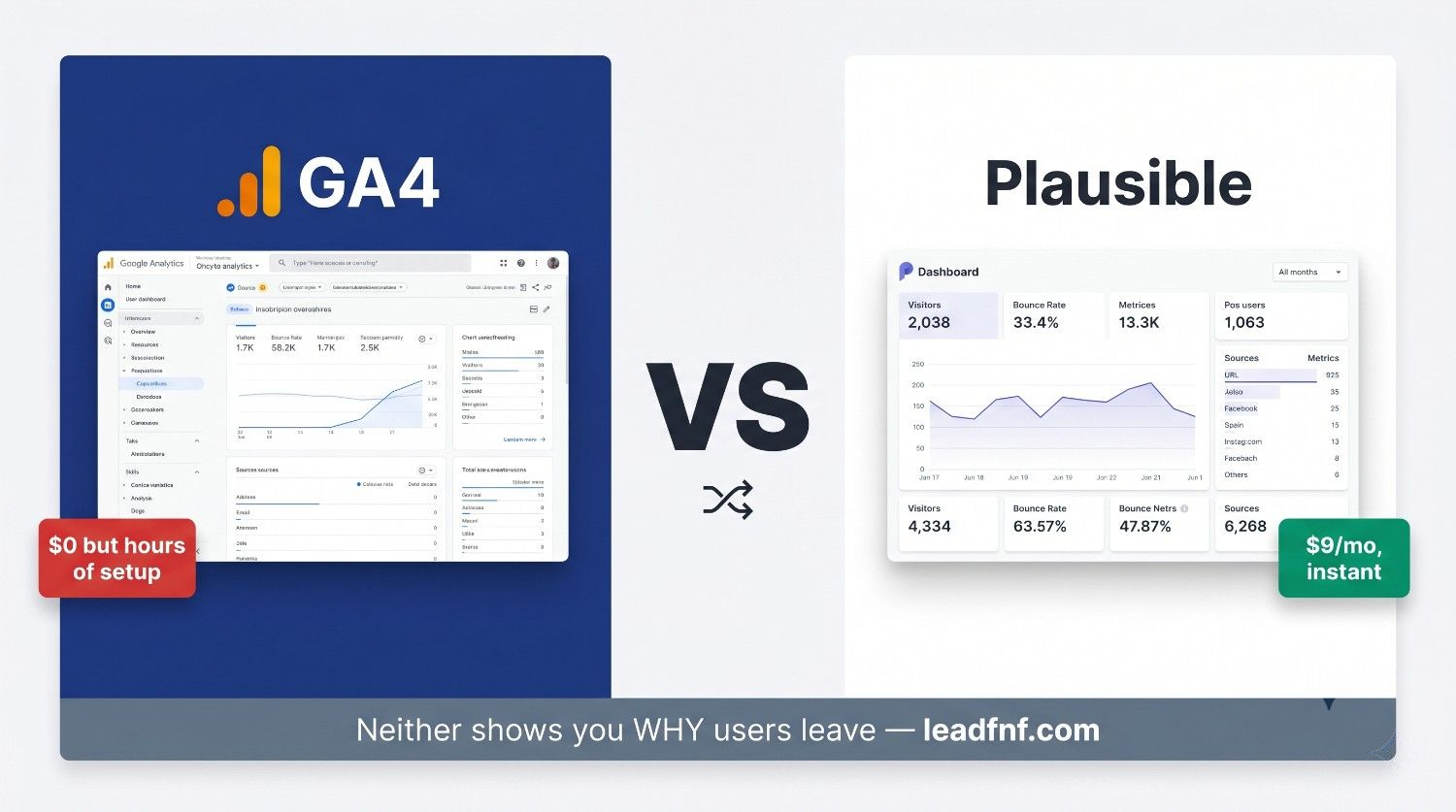

You already know the problem. You installed Google Analytics 4 because it was free and everyone told you to. Then you spent two evenings configuring events, gave up finding the bounce rate, and started wondering if there was a simpler way.
Then someone on Twitter mentioned Plausible. One script, no cookies, instant dashboard. You're tempted.
But you're running a SaaS product. You need more than pageviews. And you're not sure Plausible is enough — or whether GA4's complexity is even worth it at your stage.
This is the honest comparison. No affiliate links. No "both tools are great in their own way" hedging. Just what each tool actually does, where it fails, and how to decide.
Key Takeaways
- GA4 is powerful but leaky. In 2026, a GDPR-compliant EU consent banner causes 20–60% data loss — the etracker Consent Benchmark Report (2025) found opt-in rates of only 40–54% on tested sites.
- Plausible is accurate but shallow. No session recordings, no heatmaps, no user-level behaviour — by design and by public commitment from the founding team.
- Both leave the same gap for SaaS founders: you can see that users aren't converting, but neither tool tells you why.
- Plausible's script is ~1 KB vs GA4's ~45–75 KB — a real page-speed difference, especially on mobile (EU Picks, February 2026).
- Users running both tools in parallel report Plausible showing 20–25% more visitors than GA4 — not because Plausible inflates numbers, but because GA4 loses data to ad blockers and consent rejections (Haalytics, April 2026).
What GA4 Actually Does (And Where It Breaks Down)
Google Analytics 4 is a powerful, free, event-based analytics platform built primarily to serve Google's advertising ecosystem. It can track virtually anything on your site if you configure it correctly. That "if" is the problem.
GA4's genuine strengths for SaaS:
- Conversion funnels — track multi-step flows from landing page to signup to activation
- Traffic attribution — see exactly which channels drive your paying customers, not just visitors
- Cohort analysis — group users by acquisition date and track retention over time
- Google Ads integration — if you're running paid campaigns, GA4 is the native measurement layer
- Custom events — track any interaction on your product with full flexibility
- Predictive metrics — purchase probability, churn risk, LTV by channel
Where it breaks down:
- Configuration overhead. Finding your daily visitor count in GA4 requires clicking through multiple menus. Building a basic funnel means creating custom events, configuring a Funnel Exploration, and understanding GA4's session model. None of this is obvious.
- Data loss from consent. GA4 uses cookies and collects personal data. In the EU, that means a consent banner — and real data loss. In 2026, studies estimate that up to 40% of GA4 traffic is silently lost to ad blockers, consent rejections, and threshold filtering on small sites (TheBomb.ca, April 2026). GA4 fills this gap with "behavioural modelling" — statistical estimation — but only if you have 1,000+ daily consenting events for 7 consecutive days. Most SaaS founders never hit that threshold.
- Data sampling. At higher traffic volumes, GA4 exploration reports show sampled data — statistical estimates rather than real counts. You may be making product decisions based on approximations.
- No qualitative data. GA4 tells you 48% of users abandoned your onboarding at step 2. It cannot show you what those users saw, where they got confused, or what they clicked before leaving.
- Legal risk in the EU. France's CNIL, Austria's DSB, Italy's Garante, and several other EU data protection authorities have issued rulings against certain GA4 configurations under GDPR. The risk is manageable with Consent Mode v2 — but it requires developer work and amplifies data loss.
GA4 is excellent if you're running paid ads at scale, have a dedicated marketer, and accept the privacy tradeoffs. It's overkill and often misleading for a 5-person SaaS with under 50,000 monthly visitors. — TheBomb.ca, April 2026
What Plausible Actually Does (And Where It Stops)
Plausible Analytics was founded in 2019 by Uku Mänt and Marko Saric, bootstrapped, and has never taken outside investment. The team has made a deliberate bet: cover the 10% of analytics features that 95% of users actually look at, and cover them beautifully.
In 2026, Plausible's dashboard still fits on one screen. Everything you'd look at in a weekly review — visitors, pageviews, bounce rate, session duration, top pages, top sources, countries, devices — is visible at a glance. No menus. No custom reports. No configuration.
Plausible's genuine strengths for SaaS:
- Zero data loss. No cookies, no personal data, no consent banner required. GDPR, CCPA, and PECR compliant out of the box. What you see is real traffic, not a sampled or consent-filtered estimate.
- Instant setup. Add a ~1 KB script tag. Your dashboard is live in minutes with zero configuration.
- Page speed. Plausible's script is ~1 KB vs GA4's 45–75 KB. Switching improved Lighthouse performance scores by 3–4 points in real-world tests (EU Picks, February 2026).
- More accurate visitor counts. Users running both tools in parallel consistently report Plausible showing 20–25% more visitors — because GA4 loses data that Plausible captures (Haalytics, April 2026).
- Generous spike policy. Exceed your plan limit for one month and nothing happens. Only two consecutive months over limit triggers an upgrade prompt. One viral post won't cost you (Traffic Masters, April 2026).
- Self-hostable. The AGPL-3.0 Community Edition lets you run Plausible on your own server for free. Your data, your infrastructure.
- Funnels on the Business plan ($39/month) — basic multi-step flows, less flexible than GA4 but zero configuration required.
Where Plausible hard stops:
- No session recordings. Ever. Plausible has publicly stated they will not build session replay. If you want to watch what users do, you need a companion tool — which immediately puts you back in a two-tool, two-bill situation.
- No heatmaps. No click maps, no scroll maps, no rage-click detection.
- No user-level analytics. By design, Plausible doesn't track individual users. You see aggregate traffic, not "User A visited pricing, then docs, then dropped off."
- No cohort analysis or retention curves. For SaaS founders tracking activation and churn, this is a real gap.
- No Google Ads native integration. You can track conversions in aggregate but can't push events back into Google Ads for optimised bidding.
- Funnels paywalled to Business tier. For a tool that markets simplicity, locking basic conversion tracking behind two plan upgrades feels inconsistent (Analytics Alternatives, 2026).
Plausible doesn't try to replace Google Analytics — it covers maybe 80% of what most teams actually look at, with a 1 KB script and zero cookies. The dashboard fits on a single screen. No dropdowns. No Explorations. You open it and understand your site in under a minute. — Analytics Alternatives, 2026
GA4 vs Plausible: Side-by-Side
| Feature | GA4 | Plausible | LeadFnF |
|---|---|---|---|
| Traffic analytics | Yes | Yes | Yes |
| Session recordings | No | No — never | Yes |
| Click heatmaps | No | No — never | Yes |
| Funnel analysis | Complex setup | Business plan only | All plans |
| Cookieless by default | No | Yes | Yes |
| GDPR consent banner needed | Yes — required | Not needed | Not needed |
| Data sampling | Yes | No | No |
| AI plain-English insights | Predictive only | No | Yes |
| Google Ads integration | Native | No | No |
| Script size | ~45–75 KB | ~1 KB | Lightweight, async |
| Starting price | Free | $9/mo (10K pv) | $19/mo (all features) |
The Gap Both Tools Leave for SaaS Founders
Here is the honest thing neither GA4 nor Plausible will tell you.
Both are traffic analytics tools. They tell you how many people visited your pricing page, where they came from, and whether they bounced. That is the "what."
The "why" — why did 63% of users who reached your onboarding step 3 leave without completing it — neither tool can answer. You need session recordings and heatmaps for that. And that is where the comparison gets complicated for SaaS founders.
If you pick GA4, you still need a session recording tool (Hotjar, Microsoft Clarity, or similar) to diagnose UX problems. That is a second script, a second dashboard, and either another bill or Microsoft's data-sharing terms.
If you pick Plausible, same story. Plausible has been explicit: they will not build session recordings. Their philosophy is privacy-first minimalism. If you want to watch your users, you need another tool on top.
For content sites and blogs, this gap is fine. For SaaS products where activation, onboarding flow, and conversion rate are the business — it is a real limitation.
Plausible is probably not right for you if you need user-level behavior analytics, complex funnel analysis, or heavy attribution modeling across paid ad channels. — Haalytics, April 2026
Who Should Use GA4?
GA4 still makes sense if:
- You are running Google Ads and need native conversion tracking and audience syncing
- You have a dedicated analyst who will actually configure and use the advanced features
- You are at scale — 100K+ monthly visitors — and need cohort analysis, LTV attribution, and predictive modelling
- You need BigQuery export for custom data pipelines or BI tools
- You run a large e-commerce operation needing product-level revenue attribution
If you are a solo founder or a SaaS team of 2–10 people and none of the above applies, GA4's complexity is probably costing you more in time than it is saving you in insight.
Who Should Use Plausible?
Plausible is the right choice if:
- You run a content site, blog, or documentation site where pageviews and sources are enough
- You have EU visitors and want GDPR compliance without a consent management platform
- You are pre-product or early-stage and want traffic visibility fast with zero configuration
- You care about page speed and do not want a 75 KB script on every page
- You manage multiple sites — Plausible's $19/month Growth plan covers up to 50 sites
- You are not running paid ads and do not need Google Ads attribution
If you need to understand why users are not converting — not just that they are not — Plausible alone will not get you there.
The Middle Ground: When You Need Both
Most SaaS founders who think they need to choose between GA4 and Plausible actually have a third question: is there a tool that does traffic analytics AND shows me what users actually do on my product?
That is the gap LeadFnF was built to fill. One script gives you:
- Traffic analytics — sessions, pageviews, sources, geography
- Session recordings — watch exactly what each user did, with desktop and mobile device frames
- Click heatmaps — see where users click on every page, separated by device type
- User flow graphs — see real navigation paths, not predefined funnels
- Funnel analysis with AI commentary — find the drop-off step and get a plain-English explanation
- Built-in GDPR consent banner — no third-party CMP needed
- No cookies by default — no data loss from consent rejections
Plausible's $19/month Growth plan covers traffic for up to 50 sites. LeadFnF's $19/month Starter plan covers traffic and session recordings and heatmaps for your site. If you are a SaaS founder who needs to understand user behaviour — not just count visits — the comparison is straightforward.
Start a free 14-day trial at leadfnf.com — no credit card, all features enabled from day one.
How to Migrate: GA4 to Plausible (or LeadFnF)
Whichever tool you choose, the migration is fast:
- Run both tools in parallel for 2–4 weeks. Cross-check numbers and decide whether you are losing anything meaningful before committing.
- Export your GA4 data before removing it. Plausible's GA4 importer pulls historical aggregate data, but raw event-level exports need to be done from GA4 directly.
- Replace the script tag. Remove GA4's
gtag.jssnippet and paste the new tool's script into your. - Test with your own browser. Visit your site, complete a key flow, confirm data appears in your new dashboard within minutes.
- Remove GA4 cleanly. One fewer script means faster pages — a real benefit, not a consolation prize.
One thing to know about historical data: Plausible cannot import raw session-level GA4 data. Aggregate stats can be imported. Everything else starts fresh. Allow a 30-day adjustment period where you compare both dashboards before fully trusting the new numbers.
Frequently Asked Questions
Is Plausible good enough for SaaS?
For traffic monitoring — seeing where your users come from and which pages they visit — yes. For understanding why users are not activating or converting, no. Plausible has no session recordings, no heatmaps, and no user-level behavioural data. For SaaS founders doing serious conversion optimisation, you will need a companion tool or a different platform.
Does switching from GA4 to Plausible hurt SEO?
No. Google Search Console is a separate product from GA4 and continues working independently. Plausible even has a Search Console integration. Your rankings are unaffected by which analytics tool you use.
Is GA4 free forever?
The standard tier is free with no announced plans to change that. GA360 — the enterprise version — starts at around $150,000/year. For most SaaS founders, the standard free tier is what you would use. The cost is in configuration time, not money.
Can Plausible replace Google Analytics completely?
For content sites and blogs, yes — it covers 80–95% of what most teams actually look at. For SaaS products needing cohort analysis, retention curves, user-level behaviour, session replay, or Google Ads attribution, Plausible covers the traffic layer only. You will need additional tools for the rest.
What if I want no cookies AND session recordings?
That combination is not possible with Plausible — they have committed publicly to not building session replay. LeadFnF is cookieless by default for traffic analytics, and for session recordings uses automatic input masking plus an optional built-in consent banner to stay GDPR-compliant. It is the only tool in this price range that does both.
The Bottom Line
GA4 and Plausible are not really competing for the same user. GA4 is an enterprise-grade tool being used by people who do not need enterprise-grade analytics. Plausible is a deliberately minimal tool that solves the privacy and simplicity problem but stops at pageviews.
For a SaaS founder in 2026:
- Choose GA4 if you are running paid ads and need Google's attribution ecosystem, or if you have an analyst who will actually use the advanced features.
- Choose Plausible if you run a content-heavy site, want zero GDPR friction, and traffic counts are genuinely all you need.
- Choose something that does both traffic analytics and session behaviour if you are trying to understand why users are not converting — not just that they are not.
Try LeadFnF free for 14 days — one script, no credit card, session recordings live within 10 minutes of installation.