
If you've already decided to move away from Google Analytics — good. The harder decision is which privacy-first tool to land on. And in 2026, for most founders and small teams, the choice comes down to two: Plausible or Fathom.
They are more similar than different. Both are cookieless. Both are GDPR-compliant by default. Both fit on one screen. Both were built by small bootstrapped teams who were personally frustrated with GA4. Both will give you cleaner, more accurate traffic data than GA4 ever did.
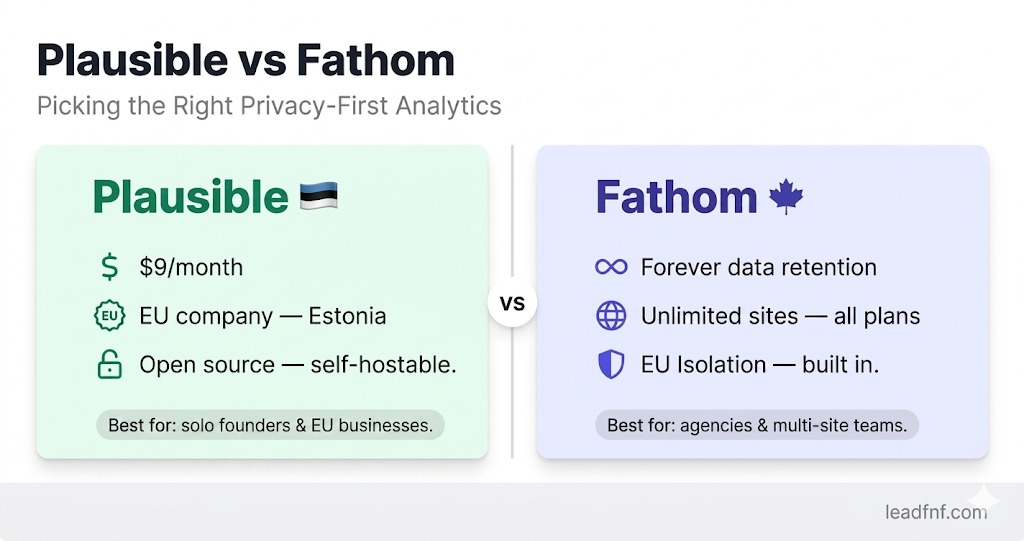
The differences are real but specific. Plausible is cheaper, open-source, and Estonian — genuinely EU-based. Fathom is $6/month more, closed-source, Canadian — not EU but has GDPR adequacy — and keeps your data forever with unlimited sites on every plan.
One honest signal: the EU Picks team paid for both tools for six months, then wrote a comparison. Their verdict was "Plausible wins for 9 out of 10 people." Then, in March 2026, they switched their own site to Fathom (EU Picks, March 2026). That paradox tells you something. The tools are close enough that the right answer genuinely depends on your specific situation.
This guide gives you the honest breakdown.
Key Takeaways
- Plausible starts at $9/month (Starter, ~10K monthly pageviews). Fathom starts at $15/month (100K pageviews). The $6 gap is real — but so are the differences that justify it (StackScored, April 2026).
- Plausible is Estonian — genuinely EU-based. For businesses whose legal teams ask "where is the data?" the answer "an EU company in Estonia" lands differently than "a Canadian company with GDPR adequacy" (EU Picks, March 2026).
- Fathom offers forever data retention on every paid plan. Plausible retains data for 3 years on Starter/Growth and 5 years on Business (Analytics Alternatives, April 2026).
- Fathom includes unlimited sites on all plans. Plausible's $9/month Starter caps at 10 sites; Growth ($14/month) covers up to 50 (CheckThat.ai, May 2026).
- Plausible is open-source (AGPL) with a self-hostable Community Edition. Fathom is closed-source — no self-hosting option.
- Neither tool has session recordings, heatmaps, or funnel analysis at all price points. Both are traffic analytics only. For SaaS founders who need to see why users aren't converting — not just that they aren't — LeadFnF fills that gap at $19/month.
What They Have in Common
Before the differences, it's worth being clear about the large shared ground. Plausible and Fathom are more similar than any other two tools in this comparison guide.
Both tools:
- Are cookieless by default — no cookies set, no persistent identifiers
- Require no GDPR consent banner for EU visitors (confirmed by CNIL and Germany's DSK guidance)
- Show all key metrics on one screen — visitors, pageviews, bounce rate, session duration, top pages, referrers, countries, devices
- Have scripts under 2 KB — meaningfully faster than GA4's 45–75 KB bundle
- Offer no data sampling — you see 100% of your real traffic, not estimates
- Never sell or share your data — both are funded by subscriptions, not advertising
- Support custom event tracking for button clicks, form submissions, and conversion goals
- Were built by small bootstrapped teams who were frustrated with GA4
If you're choosing between them, you've already made the more important decision: to use a privacy-first, cookieless tool instead of GA4. The Plausible vs Fathom choice is secondary.
Plausible: What You Need to Know
Plausible Analytics was founded in 2019 by Uku Mänt and Marko Saric, both Estonian. The company is based in Tallinn, Estonia — inside the European Union. It has grown to one of the most widely used GA4 alternatives without taking outside investment.
What Plausible does well:
- Lower entry price — $9/month for Starter (approximately 10K monthly pageviews), $14/month for Growth (higher pageview limits, funnels, custom properties). Annual billing saves roughly two months (CheckThat.ai, May 2026).
- Open-source (AGPL) — the codebase is publicly auditable. Security teams and privacy-focused organisations can read exactly how data is processed. The self-hostable Community Edition is free for organisations willing to manage their own infrastructure.
- EU-based by incorporation — for buyers whose legal or procurement teams ask about data jurisdiction, "the company is incorporated in Estonia, a European Union member state" is the cleanest possible answer.
- Funnel analysis — available on Business plan, Plausible supports multi-step funnel configuration that Fathom does not offer.
- Google Search Console integration — connects keyword data directly to your analytics dashboard.
- Generous multi-site support — Growth plan covers up to 50 sites. Business covers more.
- Non-profit/education discount — 15% off annual Business billing for qualifying organisations.
Where Plausible falls short:
- Data retention is finite — 3 years on Starter and Growth, 5 years on Business. If you want to look at traffic from four years ago, you need the Business plan or self-hosting.
- No ad blocker bypass by default — Plausible offers a custom domain proxying option, but it requires DNS configuration. Not as seamless as Fathom's built-in solution.
- Sites capped per plan — Starter allows 10 sites. Growth allows 50. Fathom includes unlimited sites on every paid plan regardless of tier.
- No uptime monitoring — Fathom includes basic uptime monitoring built in. Plausible doesn't.
- Funnels locked to Business tier — if you want funnel analysis and you're on Starter or Growth, you can't access it.
Fathom: What You Need to Know
Fathom Analytics was founded in 2018 by Jack Ellis and Paul Jarvis — a developer and a writer, both Canadian. They are the longest-standing bootstrapped team in the privacy-first analytics category, predating Plausible by a year. The product is closed-source, hosted only (no self-hosting option), and has built a loyal following particularly among bloggers, creators, and agencies.
What Fathom does well:
- Forever data retention — every paid plan retains your data indefinitely. No retention tier, no upgrade required to see traffic from three years ago (Analytics Alternatives, April 2026).
- Unlimited sites on every plan — the $15/month plan covers as many sites as you want to add. For agencies managing 10–50 client sites, this is a significant practical advantage over Plausible's per-tier site limits.
- EU Isolation — EU visitor traffic is routed through European-owned infrastructure, producing a Schrems-II-robust data flow for clients in Germany, France, or other markets with strict data transfer expectations (NewMetrics, 2026).
- Ad blocker bypass — pioneered by Fathom — Fathom routes its tracking script through a CDN that bypasses most ad blockers by default, with no DNS configuration required. This gives more accurate visitor counts for technical audiences.
- Stats API on all plans — full programmatic access to your analytics data is included on every paid tier.
- Cleaner, more polished UI — subjective, but consistently noted. Fathom's dashboard looks more refined and is frequently cited as the most professional-looking in the category (EU Picks, March 2026).
- Uptime monitoring included — Fathom monitors your site's uptime and alerts you if it goes down. Unusual feature for an analytics tool but appreciated.
- Bootstrapped since 2018 — the longest track record in this category. If longevity and proven stability matter to your procurement or client conversations, Fathom's eight-year track record carries weight.
Where Fathom falls short:
- Higher starting price — $15/month vs Plausible's $9/month for comparable traffic. Over a year, that's $72 more for the same base functionality.
- No free tier — Fathom offers a 7–30 day trial but has no free plan. Plausible has a community edition for self-hosting. If budget is tight, Fathom requires commitment from day one.
- Closed-source — unlike Plausible, Fathom's code is not publicly auditable. For security teams or organisations that require open-source tooling, this is a disqualifier.
- No self-hosting option — you cannot run Fathom on your own server. Your data lives in Fathom's infrastructure (Canadian company, EU traffic via EU infrastructure). For organisations that require on-premises data control, this rules Fathom out.
- No funnel analysis — Fathom has goal tracking and conversion events, but no multi-step funnel visualisation.
- No Google Search Console integration — Plausible connects directly to GSC to show keyword data. Fathom does not.
- Canadian company — Canada has GDPR adequacy status, meaning data transfers from the EU are legally valid. But "Canadian company with adequacy" is not the same as "EU company" when legal teams or enterprise procurement get involved.
The 5 Differences That Actually Matter
Ignore the feature table noise. These five differences are the ones that change the decision.
1. Price: $9/month vs $15/month
For a single site with moderate traffic, Plausible is $6/month cheaper. Over a year, that's $72. For an agency managing 20 sites, the unlimited-sites Fathom plan at $15/month beats Plausible's per-tier site limits significantly. The price comparison depends entirely on how many sites you're running.
Simple rule: One site → Plausible. Multiple sites (especially agencies) → Fathom.
2. Data jurisdiction: EU vs Canada
Plausible is incorporated in Estonia — EU. Fathom is incorporated in Canada — GDPR adequacy, but not EU. For most small teams, this distinction is invisible. For enterprise procurement, regulated industries (healthcare, finance, legal), or German clients whose legal teams run vendor questionnaires, it matters.
Simple rule: EU company required → Plausible. Canada-with-adequacy acceptable → either works.
3. Data retention: 3–5 years vs forever
Plausible retains data for 3 years (Starter/Growth) and 5 years (Business). Fathom keeps it forever. If you're planning to run your site for more than five years and want historical traffic data going back to day one, Fathom's forever retention has meaningful long-term value.
Simple rule: Historical data beyond 5 years matters → Fathom. 3–5 years is sufficient → either works.
4. Open source vs closed source
Plausible is AGPL open-source with a self-hostable Community Edition. Fathom is closed-source with no self-hosting. If you want to read the code, audit the data processing, or run the tool on your own infrastructure, Plausible is the only option.
Simple rule: Open source or self-hosting required → Plausible. SaaS-only is fine → either works.
5. Ad blocker bypass: configuration needed vs built-in
Fathom bypasses most ad blockers by default through its CDN routing — no configuration needed, more accurate visitor counts for technical audiences. Plausible offers a custom domain proxying option that achieves the same result but requires DNS setup.
Simple rule: Technical audience, high ad-blocker prevalence, don't want to configure DNS → Fathom. Happy to set up a custom domain → Plausible.
Side-by-Side Comparison
| Feature | Plausible | Fathom | LeadFnF |
|---|---|---|---|
| Starting price | $9/month | $15/month | $19/month |
| Free tier | Community Edition (self-host) | Trial only | 14-day trial |
| Cookieless by default | Yes | Yes | Yes |
| GDPR consent banner needed | No | No | No (analytics) |
| Company location | Estonia (EU) | Canada (adequacy) | Pakistan |
| EU data residency | Included | EU Isolation option | Configurable |
| Data retention | 3–5 years by plan | Forever | Plan-based |
| Open source | AGPL — auditable | Closed source | Closed source |
| Self-hostable | Community Edition | No | No |
| Sites per plan | 10–50 by plan | Unlimited | Per plan |
| Ad blocker bypass | Custom domain (manual) | Built-in by default | Lightweight script |
| Funnel analysis | Business plan only | No | All plans |
| Session recordings | No — never | No — never | Yes — included |
| Click heatmaps | No — never | No — never | Yes — included |
| AI insights | No | No | Yes — included |
| Google Search Console | Yes | No | No |
| Uptime monitoring | No | Yes — built in | No |
| Stats API | Business plan | All plans | Coming |
Pricing in Plain Numbers
Plausible (as of May 2026):
| Plan | Price | Pageviews | Sites | Retention |
|---|---|---|---|---|
| Starter | $9/month | ~10K/month | 10 sites | 3 years |
| Growth | $14/month | Higher limits | 50 sites | 3 years |
| Business | Contact | Custom | Unlimited | 5 years |
Annual billing saves approximately 2 months (16.7% discount). Non-profit/education: 15% off Business annual.
Fathom (as of May 2026):
| Plan | Price | Pageviews | Sites | Retention |
|---|---|---|---|---|
| Entry | $15/month | 100K/month | Unlimited | Forever |
| Higher tiers | Scales up | Higher limits | Unlimited | Forever |
Annual billing available. 7–30 day free trial before first payment.
The multi-site maths: An agency managing 10 client sites pays Plausible's Growth plan at $14/month (50 sites included) or Fathom's entry plan at $15/month (unlimited sites). At this level, Fathom's $1 premium is easily justified by forever retention and the ad blocker bypass. Managing 3 sites or fewer on a personal budget → Plausible's $9/month is hard to beat.
4 Scenarios: Which One to Pick
Scenario 1: Solo founder, one SaaS, budget-conscious
You're running one product, you want accurate traffic data without GA4's complexity, and you want to spend as little as possible while staying GDPR-compliant.
Pick Plausible. $9/month, one site, cookieless, no consent banner, accurate data from day one.
Scenario 2: Agency managing multiple client sites
You're running 10–30 client sites and need a single analytics platform that handles all of them on one bill. You also want dashboards that look clean enough to show clients without embarrassment.
Pick Fathom. Unlimited sites on every plan, the most polished UI in the category, and forever retention means client data from year one is still accessible in year five (Analytics Alternatives, April 2026).
Scenario 3: EU-based business or enterprise procurement
Your legal team, your clients' procurement team, or your industry regulator requires EU-based data processing with auditable code. "Canada with adequacy" doesn't pass muster.
Pick Plausible. Estonian incorporation, AGPL open source (auditable), EU data residency included, self-hostable if required.
Scenario 4: Developer-heavy audience, high ad-blocker prevalence
Your users are developers, designers, or technical professionals. Ad blocker adoption in your audience is 30–50%. You're already losing a significant percentage of visitors to GA4's script being blocked.
Pick Fathom. Fathom pioneered the CDN-based ad blocker bypass and it works by default — no DNS configuration, no custom domain setup, more accurate counts out of the box (NewMetrics, 2026).
The Gap Both Tools Leave
Here is the honest limitation that every Plausible vs Fathom comparison should state clearly: both tools are traffic analytics and nothing more.
They tell you how many people visited your site, where they came from, and which pages they viewed. They do not tell you what those people did while they were on your site. No session recordings. No heatmaps. No rage click detection. No funnel visualisation of what happened between pages.
For a content site or marketing blog, this is fine — traffic counts and source data are largely sufficient.
For a SaaS product where you're trying to understand why users aren't converting on your pricing page, why onboarding has a 60% drop-off at step 3, or why your CTA isn't being clicked — both Plausible and Fathom leave you guessing.
You need a companion tool for that. The typical pairing is Plausible or Fathom for traffic analytics, plus Hotjar or Microsoft Clarity for session recordings and heatmaps — two scripts, two dashboards, two bills.
LeadFnF was built to eliminate that second tool. One script gives you:
- Traffic analytics — sessions, pageviews, sources, geography, device breakdown (the Plausible/Fathom side)
- Session recordings — watch exactly what users did, with mobile and desktop device frames
- Click heatmaps — separated by device so mobile and desktop patterns don't blur
- User flow graphs — see actual navigation paths between your pages
- Funnel analysis with AI commentary — find the drop-off step and get a plain-English explanation
- Built-in GDPR consent banner — activates only for session recordings, not traffic analytics
Starting at $19/month. 14-day free trial, no credit card.
For some teams the right answer is Plausible ($9/month) + LeadFnF ($19/month) = $28/month total. You get bulletproof privacy-first traffic analytics from an EU company, plus full session behaviour from one additional script. That combined stack costs less than Hotjar's entry plan alone.
Frequently Asked Questions
Is Plausible or Fathom more accurate?
Both are more accurate than GA4 for most sites because neither is blocked by GDPR consent rejections. Fathom has a slight edge on ad blocker accuracy because its CDN bypass is built in by default. Plausible can match this with custom domain proxying but requires DNS configuration. For non-technical audiences where ad blocker rates are low (5–10%), the difference is negligible.
Can I self-host Plausible or Fathom?
Plausible yes — the AGPL Community Edition is free to self-host and actively maintained. Fathom no — there was an early open-source version called Fathom Lite but the current commercial product is closed-source and hosted only.
Which has better customer support?
Both offer email support. Fathom is frequently cited for responsive, personal support — consistent with a founder-led team. Plausible offers extensive public documentation and email support but is more documentation-first. For complex technical issues, both teams are reachable. Fathom has a slight edge on support responsiveness in independent reviews.
Do either offer a Google Ads integration?
Neither integrates with Google Ads for conversion tracking or bidding optimisation. Both are positioned as GA4 alternatives for organic traffic understanding. If Google Ads conversion tracking is essential to your operations, you need to either keep GA4 or implement Google Ads conversion tags separately.
What happens if I exceed my pageview limit?
Both tools handle overages graciously. Plausible continues tracking and notifies you to upgrade; your data is not lost. Fathom also continues tracking and bills on a higher tier. Neither tool cuts off your data or surprises you mid-month with a data gap.
Can I migrate from one to the other?
Yes. Both tools export data via CSV. Historical aggregate stats (total pageviews, top pages, referrers) are exportable. Raw session-level data is not retained in either tool by design, so there's no raw event data to migrate. Most teams simply switch the script tag and accept a clean-start date on the new platform.
The Bottom Line
Plausible wins for most people most of the time. It's cheaper, open-source, EU-incorporated, and getting more feature-complete with every update. If you're a solo founder, a small SaaS team, or an EU-based business with procurement scrutiny, Plausible is the default right answer.
Fathom wins in specific situations: agencies managing many sites who need unlimited sites and forever retention, technical audiences where ad blocker bypass matters, and clients or organisations where the polished UI is the difference between a product they'll actually check and one they ignore.
Neither tool is wrong. Both are meaningfully better than GA4 for the vast majority of small sites that don't need Google's advertising ecosystem.
The decision that matters more: once you've picked your traffic analytics tool, make sure you have a way to see what users do on your site — not just that they were there. Traffic counts answer "how many." Session recordings and heatmaps answer "why."
Try LeadFnF free for 14 days — traffic analytics, session recordings, and heatmaps from one script, starting at $19/month. No credit card required.